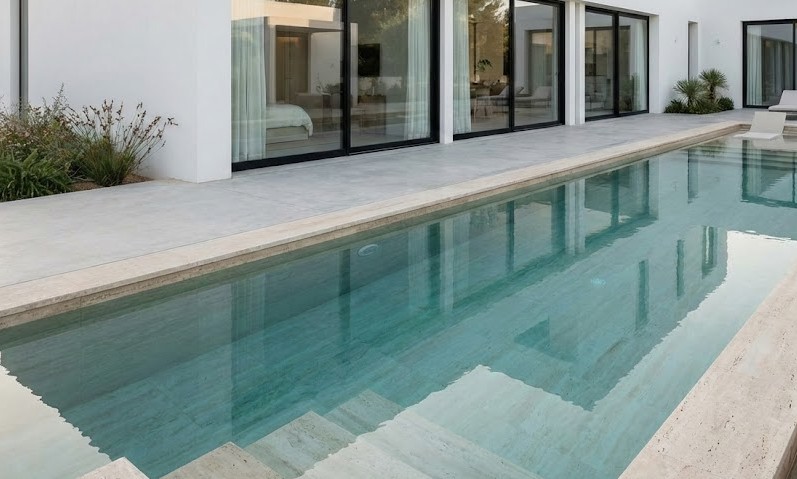
A swimming pool is the heart of a Pool Villa but it’s also the part that can cause owners the most headaches. If the system isn’t aligned with the pool size, pipework, and real usage patterns, the results are often the same: green water, recurring algae, strong odour, or frequent repairs.
Clear water that’s easy to maintain isn’t luck. It’s the outcome of a system “balance” designed from day one.
Many people begin with the question, “Saltwater or chlorine?” In practice, water quality depends far more on the balance between key components: the pump, filter, piping, valves, return jets/skimmers, and the plant room.
System Note:
Even premium equipment can still be hard to maintain if pressure drops from poor pipe routing, or if dead zones exist because return jets don’t provide full coverage.
A “stable” system is one that makes pH/chlorine/circulation easy to control and allows maintenance access without having to demolish surrounding finishes.
What should exist from day one is a clear as-built system plan, so future servicing is fast and issues don’t escalate into wider damage.
Saltwater vs chlorine: choose based on usage and environment
Chlorine system
The advantage is easier cost control at the start, most technicians are familiar with it, and parts are easy to source. But you must follow a consistent testing and chemical top up schedule.
Saltwater system
In many cases it reduces the chlorine smell and feels gentler on the skin, but it requires corrosion-resistant equipment and correct system settings matched to the actual pool size.
Decision Note:
Selection should be based on usage patterns e.g., daily use vs occasional use because stability of water quality is affected differently.
For pools near the sea or in areas with salt air, pay attention to hardware and metal components around the pool, not only what’s inside the plant room.
No matter the system, there should be a routine testing plan, with fill and drain points designed for convenience to reduce neglect.
Turnover & flow are the core of “clear water”
A good pool must circulate water through filtration at an appropriate turnover rate, and the flow must reach the entire pool to avoid dead zones. Dead zones are areas where water barely moves algae will keep returning to the same spots, even if you increase chemicals.
Hydraulic Note:
Pools with steps, stairs, or multiple corners require broader jet coverage; otherwise, the dirty spots will return repeatedly.
Skimmer placement shouldn’t be chosen for aesthetics alone it should account for wind direction and surface debris behaviour (leaves, dust) so the pool can genuinely “sweep” the surface.
A stronger pump is not always better: it can be noisy, consume more power, and accelerate wear if it isn’t matched to filter size and the piping system.
Waterproofing and joints: where to invest from the start
Leaks are hard to fix because the root cause often sits in the structure and joint details. Prevention must be approached as a system — not as a single waterproofing coat and done.
Construction Note:
High-risk points are usually pool corners, floor–wall junctions, and pipe penetrations through the structure. Site preparation and execution details matter more than the brand name of materials.
Tile installation and grout are part of the system. If materials aren’t suitable for permanent submersion, problems like detachment, staining, or seepage along grout lines will follow.
Design inspection and repair access points don’t conceal everything until repairs require tearing up the deck or landscaping.
The pool plant room: you don’t want to see it but it must be done well
A well-designed plant room reduces problems significantly: noise, safety risks, and repair time.
Operation Note:
The plant room should be easy to access, have real working space, good ventilation, and protection from rain.
Avoid placing it adjacent to bedrooms or relaxation areas pump noise and vibration affect long-term comfort.
Allow space for maintenance and future equipment replacement so technicians don’t have to dismantle surrounding areas or move parts through main living spaces.